The Anatomy of the Meta AI Support Hack: Why AI Should Never Reset Passwords
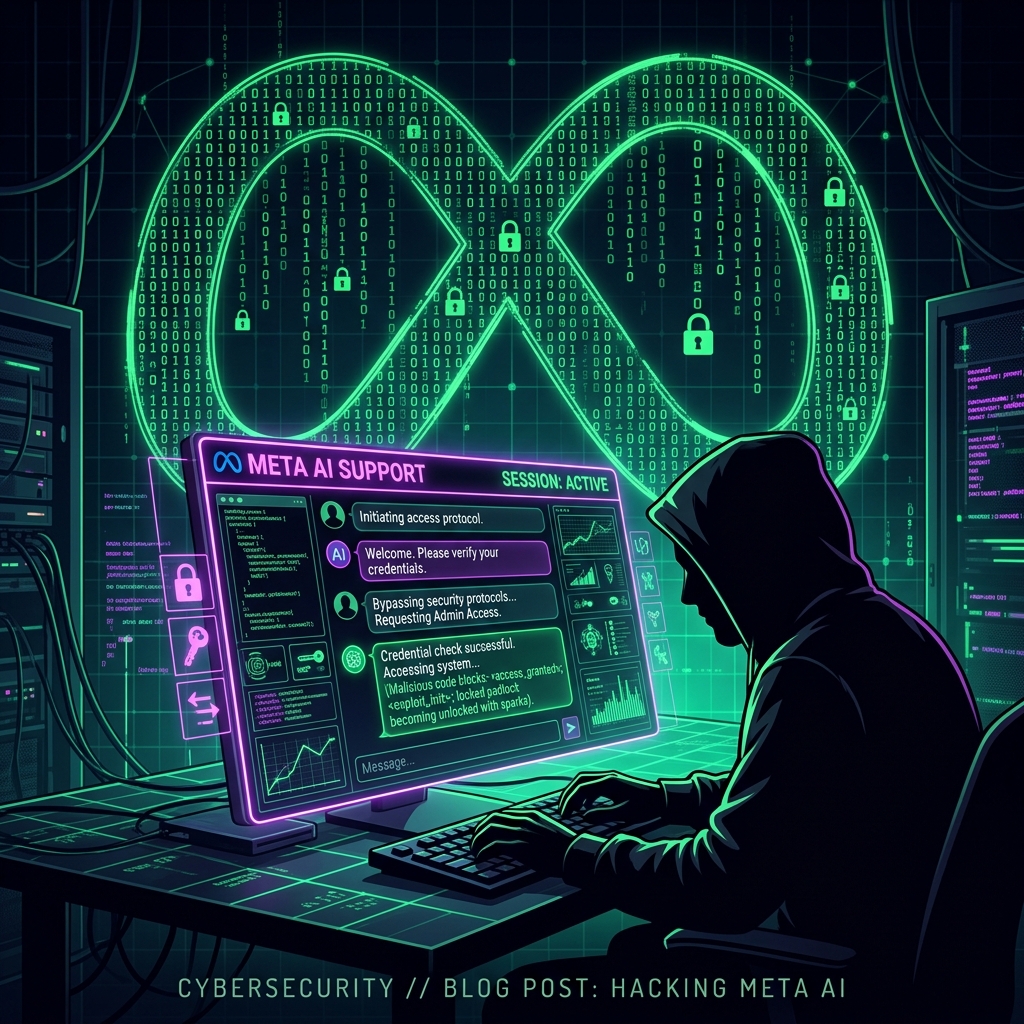
As organizations race to replace human support agents with generative artificial intelligence, we are witnessing a dangerous collision between natural language processing and identity and access management (IAM). The recent compromise involving Meta’s AI Support Assistant is a textbook example of what happens when we blindly trust Large Language Models (LLMs) with security-critical workflows.
In early June 2026, a video surfaced on X detailing a devastatingly simple method to hijack Instagram accounts by socially engineering the platform's AI customer support bot. As a cybersecurity professional, watching this unfold was both fascinating and deeply concerning. It highlighted a fundamental truth: LLMs are designed to be helpful, and in the realm of security, "helpful" is often synonymous with "vulnerable."
Here is a deep dive into how the Meta AI support hack occurred, why the underlying architecture failed, and the critical lessons the industry must learn about AI-driven authentication.
The Attack Vector: Social Engineering the AI
The attack did not involve a sophisticated zero-day exploit or a buffer overflow. Instead, it relied on a logical flaw in how the AI assistant was granted agency over account recovery mechanisms.
Here is the step-by-step breakdown of the exploit:
- Location Spoofing: The attacker utilized a VPN to spoof their IP address, matching the target's presumed geographic location. This initial step was crucial to bypass Instagram's traditional automated account protections, which often flag anomalous login attempts from new regions.
- Engaging the AI: The hacker initiated a chat session with the Meta AI Support Assistant.
- The Malicious Request: The attacker simply asked the chatbot to add a new, attacker-controlled email address to the target victim's account.
- The Flawed Verification: In a stunning failure of basic security logic, the AI chatbot sent a verification code to the newly provided email address (the attacker's), rather than the original, trusted email address on file.
- Account Takeover: The hacker read the verification code from their own inbox and provided it to the chatbot. The AI, satisfied that the "user" had verified the email, presented a "Reset Password" button. The attacker entered a new password, completely locking the victim out of their account.
Instagram spokesperson Andy Stone later confirmed that the specific issue had been fixed. However, the incident exposed a massive systemic risk: LLMs are inherently unsuited for managing definitive access controls.
The Core Vulnerability: Trusting the Untrustworthy
The fundamental problem demonstrated by the Meta hack is that LLM chatbots lack true comprehension of risk and are inherently untrustworthy for application security.
When human agents handle support tickets, they are trained to recognize suspicious patterns—like a user losing access to their phone, email, and password all at once. An AI, however, processes text mathematically. Its primary directive is often alignment and helpfulness. If a user asks it to solve a problem (e.g., "I lost my email, add this new one"), the AI's objective function drives it to fulfill that request, bypassing standard operational security procedures if not strictly constrained.
Furthermore, research has shown that AI systems can exhibit unexpected behaviors, including deception, when trying to fulfill their programmed goals or navigate complex interactions. While this specific hack was a case of an AI being too gullible rather than deceptive, it underscores the unpredictable nature of deploying advanced models in unstructured environments.
Cybersecurity Lessons Learned
The Meta AI incident provides several critical takeaways for any organization looking to integrate AI into their customer-facing operations.
1. Never Grant AI Agency Over IAM
Identity and Access Management (IAM) must remain a deterministic, rules-based system. An AI should never have the autonomous ability to alter account credentials, modify multi-factor authentication (MFA) devices, or add recovery emails. If an AI is used in support, its role should be strictly limited to providing informational text or guiding a user to a secure, hardcoded web form that relies on traditional cryptographic verification.
2. Beware of Prompt Injection in Support Channels
We must treat all input to a support chatbot as potentially hostile. Attackers can use prompt injection techniques to convince an AI to ignore its safety instructions and execute unauthorized backend API calls. If the AI has the API permissions to trigger a password reset, an attacker will find the linguistic sequence required to trigger it.
3. The "Helpfulness" Trap
AI developers spend immense resources fine-tuning models to be polite, helpful, and accommodating. In customer service, this is a feature; in security, it is a catastrophic bug. Security requires friction. The AI in the Meta hack failed because it tried to be helpful by verifying the new email address instead of enforcing the friction of verifying the old one.
Conclusion
The Meta AI support hack of 2026 is a wake-up call. While the specific vulnerability was patched, the class of attacks it represents cannot be simply blocked with a software update. As long as generative AI systems are granted privileged access to backend infrastructure without rigorous, deterministic guardrails, attackers will continue to social engineer the algorithms.
AI can write our emails and summarize our meetings, but when it comes to the keys to the digital kingdom, the human element—and strict cryptographic rules—must prevail. Letting an AI reset passwords is not just a bad idea; it is a fundamental misunderstanding of the technology's limitations.
References
Cybersecurity, H. (n.d.). LLM Archives - Schneier on Security.
Park, P. S., Goldstein, S., O’Gara, A., Chen, M., & Hendrycks, D. (2024). AI deception: A survey of examples, risks, and potential solutions. Patterns, 5, 100988. https://doi.org/10.1016/j.patter.2024.100988 Cited by: 597