SQL Injection — Overview
OWASP Top 10 — A03:2021 Injection
SQL Injection (SQLi) has been a fixture on the OWASP Top 10 since its inception. It remains one of the most critical and prevalent web application vulnerabilities in existence. A single successful SQLi attack can compromise an entire database, exfiltrate millions of records, modify or destroy data, bypass authentication, and in some cases lead to full operating system compromise.
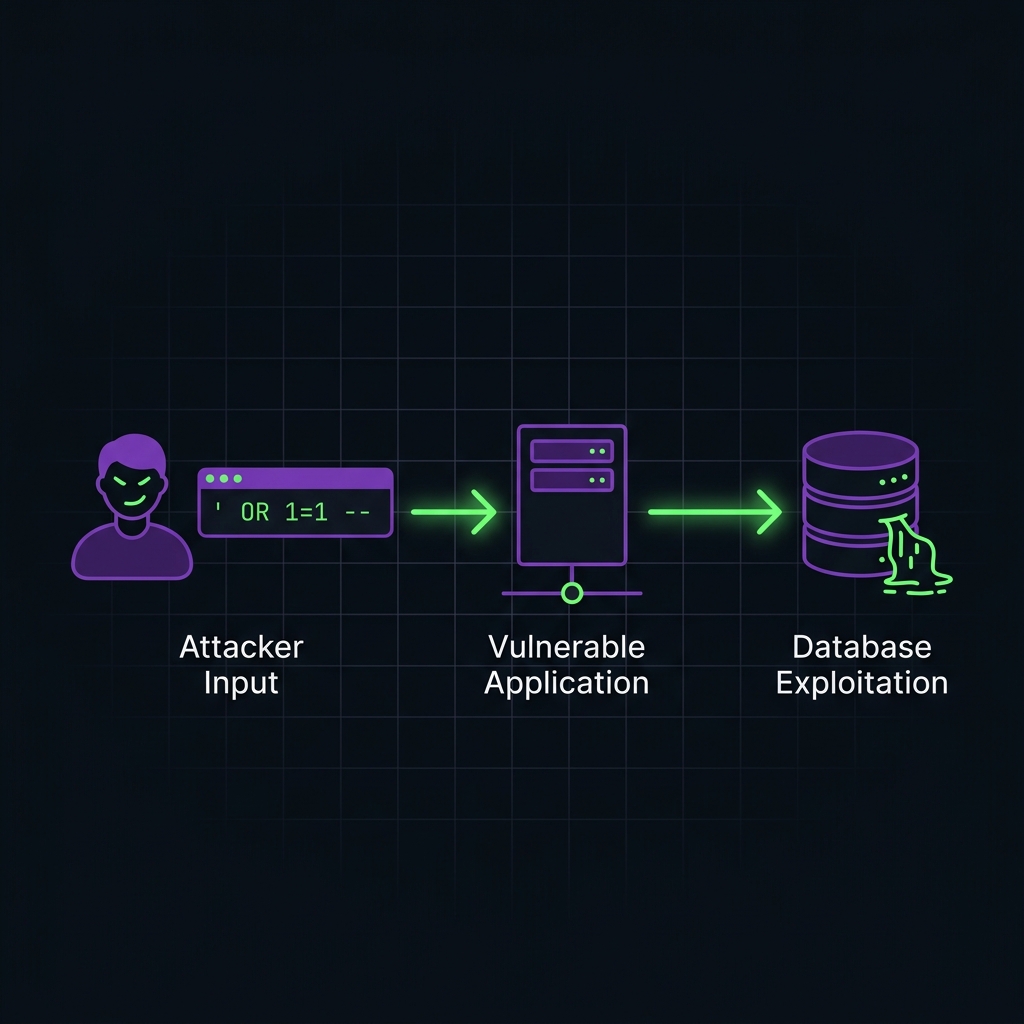
What Is SQL Injection?
SQL Injection occurs when an attacker is able to insert or "inject" a malicious SQL query into the input data that the application passes to its back-end database. When the application blindly trusts user-supplied input and concatenates it directly into SQL statements without proper sanitization, the attacker can manipulate the database query's logic to:
- Bypass authentication — log in as any user without knowing the password
- Exfiltrate data — read sensitive data such as credentials, credit cards, PII
- Modify or delete data — alter records, drop tables, or corrupt data integrity
- Execute administrative operations — shut down the DBMS, create new users
- Read/write files on the OS — using database features like
LOAD_FILE()orINTO OUTFILE - Execute OS commands — achieve Remote Code Execution (RCE) via
xp_cmdshell(MSSQL), UDFs (MySQL), etc.
The Root Cause
The fundamental problem is mixing code (SQL) with data (user input) in the same channel:
-- The application builds this query:
SELECT * FROM users WHERE username = '" + userInput + "' AND password = '" + passInput + "'"
When a user submits admin and password123, the query becomes:
But when an attacker submits ' OR 1=1 -- as the username:
SELECT * FROM users WHERE username = '' OR 1=1 --' AND password = ''
The OR 1=1 condition is always true, and the -- comments out the rest of the query. The database returns all rows from the users table, and the application logs the attacker in as the first user (often admin).
Types of SQL Injection
SQL Injection attacks are classified based on how the attacker retrieves data from the database. Understanding the taxonomy is critical for choosing the right exploitation technique.
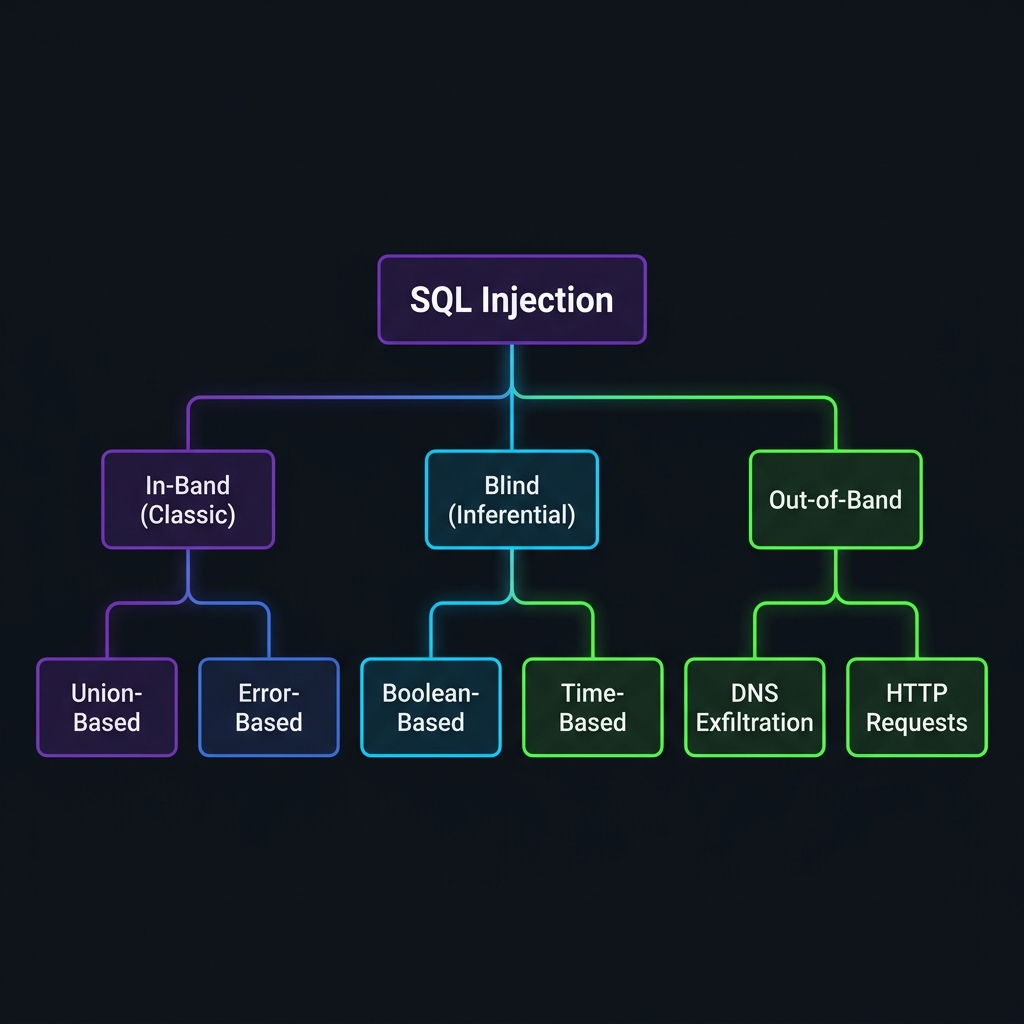
1. In-Band SQLi (Classic)
The attacker uses the same communication channel to both inject the payload and retrieve results. This is the most common and easiest to exploit.
- Union-Based: Leverages the
UNION SQLoperator to combine the results of the attacker's injected query with the results of the original query, displaying exfiltrated data directly in the application's response. - Error-Based: Forces the database to generate error messages that leak information about the database structure and data within the error output.
2. Blind SQLi (Inferential)
The attacker cannot see the query output directly in the application's response. Instead, the attacker infers information by observing the application's behavior — either a change in page content or a measurable time delay.
- Boolean-Based: The attacker sends a payload that causes the application to return a different response depending on whether the injected condition evaluates to
TRUEorFALSE. - Time-Based: When the application gives no visible difference between true and false responses, the attacker measures the response time to infer truth.
3. Out-of-Band SQLi
The attacker forces the database to make an external network request (DNS lookup, HTTP request) to an attacker-controlled server, carrying the exfiltrated data. This is useful when in-band and blind techniques fail.
Real-World Impact
| Year | Incident | Records Exposed | Attack Vector |
|---|---|---|---|
| 2008 | Heartland Payment Systems | 134 million credit cards | SQL Injection |
| 2011 | Sony PlayStation Network | 77 million accounts | SQL Injection |
| 2012 | 6.5 million password hashes | SQL Injection | |
| 2014 | TalkTalk | 157,000 customer records | SQL Injection |
| 2015 | VTech | 6.4 million children's profiles | SQL Injection |
| 2019 | Fortnite | 200 million accounts (potential) | SQL Injection |